
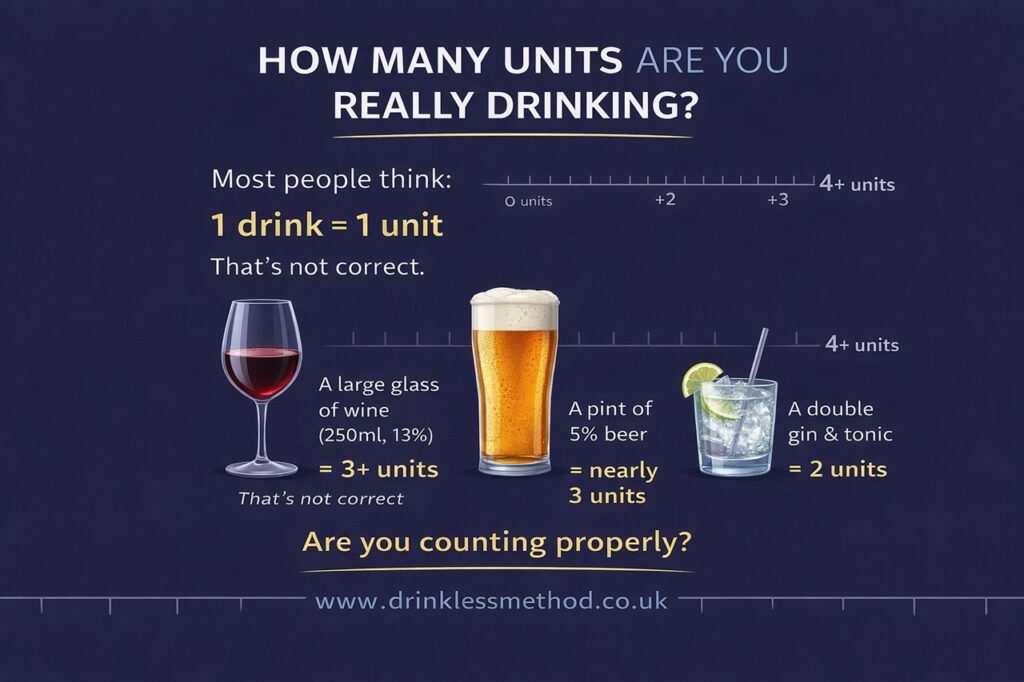
Most people don’t deliberately exceed the UK alcohol guideline of 14 units per week. In fact, many people consider themselves “moderate drinkers.” The issue is rarely intention — it is usually calculation.
Understanding alcohol units is the first step toward reducing drinking safely and sustainably.
What Is an Alcohol Unit in the UK?
An alcohol unit is a measure of pure alcohol. One unit equals 10ml (or 8g) of pure alcohol. The number of units in your drink depends on two factors:
- The volume of the drink
- The strength (ABV) of the drink
For example:
- A 175ml glass of 13% wine = approximately 2.3 units
- A 250ml large glass of wine = around 3 units
- A pint of 5% beer = roughly 2.8 units
The recommended UK guideline is no more than 14 units per week, ideally spread across several days.
Yet many people unintentionally double or triple this amount.
Why Most People Underestimate Their Weekly Alcohol Units
Most people count:
- Glasses
- Bottles
- Occasions
They do not calculate:
- ABV strength
- Exact glass size
- Cumulative weekly totals
Two “normal” glasses of wine after work can easily equal 6 units. If that pattern repeats four times per week, that alone totals 24 units — already significantly above guidelines.
Weekend drinking often adds more. A Friday night with friends can account for 8–12 units in one sitting.
What feels moderate can quickly become excessive.
When Moderate Drinking Becomes Habitual Drinking
Many people seeking alcohol reduction describe the same pattern:
“I didn’t realise how much it was adding up.”
Drinking becomes routine:
- A glass while cooking
- A glass while watching television
- A drink to unwind after work
Over time, the behaviour becomes automatic rather than intentional.
This is not necessarily alcohol dependence. It is habit reinforced by the brain’s reward pathway.
The Neurological Link Between Alcohol and Reward
Alcohol stimulates the release of endorphins and dopamine in the brain. These chemicals reinforce the behaviour, making repetition more likely.
For some people, awareness alone is enough to reduce drinking. For others, willpower becomes inconsistent — particularly during stress, boredom, or social situations.
This is where evidence-based medical approaches may be considered.
Naltrexone, a clinically researched medication used in alcohol reduction, works by blocking opioid receptors involved in alcohol reward. Over time, this weakens the association between alcohol and pleasure, helping reduce cravings and binge patterns.
It does not require complete abstinence. It supports controlled reduction when clinically appropriate.
How to Start Reducing Alcohol Units Safely
If you are wondering how to reduce drinking in the UK, begin with these steps:
- Track your units for one full week
- Measure wine rather than free-pouring
- Note which days trigger higher consumption
- Identify patterns (stress, boredom, social)
Awareness creates leverage.
For some, behavioural change is sufficient. For others, combining behavioural strategies with medical support leads to more sustainable alcohol reduction.
Understanding Your Units Is the Foundation of Control
You do not need to label yourself.
You do not need to stop entirely.
But you do need to know your numbers.
Understanding alcohol units is not about judgement — it is about clarity.
Reducing drinking begins with awareness. Maintaining change often requires support.
If you would like to explore the five most common alcohol unit misunderstandings, see:
- Alcohol Units for Women
- Alcohol Units for Men
- “I Only Drink at Weekends”
- Know Your Units. Know Your Habits
Each addresses a different pattern of unit miscalculation and practical steps for regaining control.