
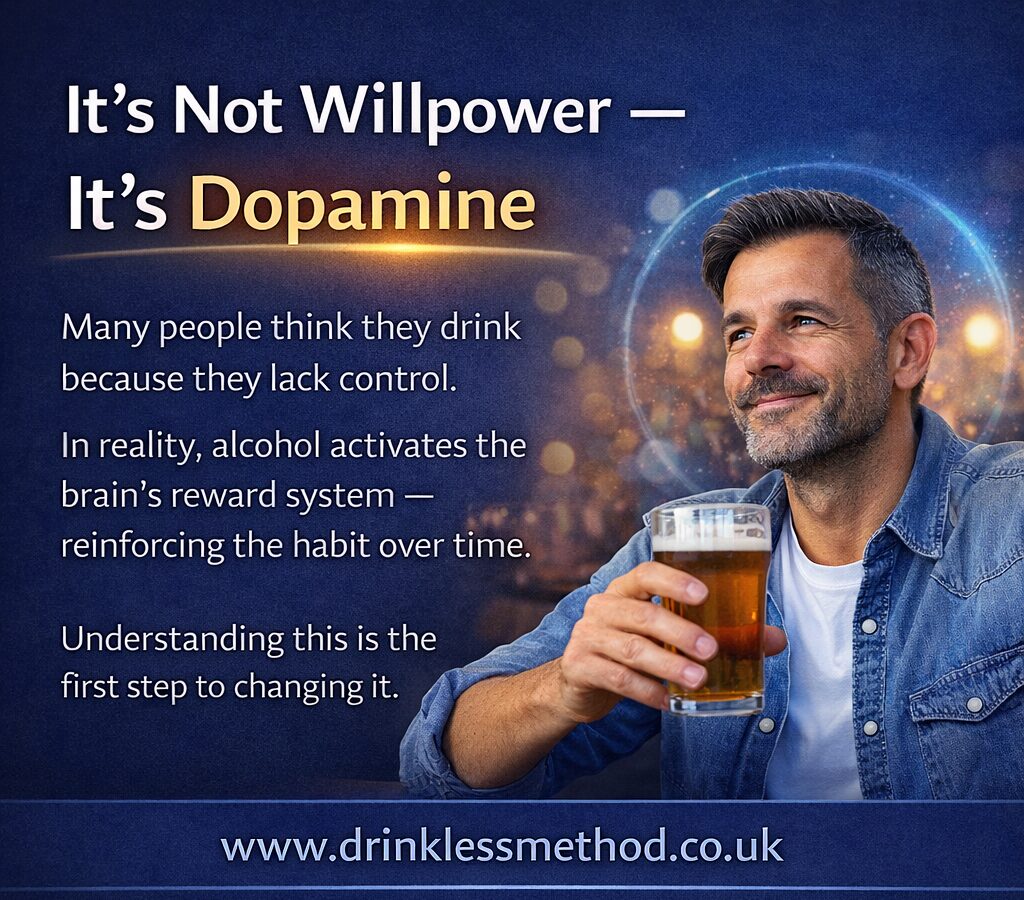
It Starts With Intention
Most people don’t set out to drink too much. A glass of wine after work or a couple of drinks at the weekend feels reasonable and controlled.
However, many find that one drink becomes two, and two becomes more. This pattern is incredibly common — and it has a neurological explanation.
Dopamine: The Hidden Driver
Alcohol stimulates the release of dopamine, the brain’s reward chemical. This creates a sense of pleasure and reinforcement.
Each time this happens, the brain learns:
“This is something worth repeating.”
Over time, this creates a feedback loop where drinking becomes less of a conscious choice and more of a learned behaviour.
Why Awareness Matters
Understanding that alcohol affects dopamine changes how we view drinking. It shifts the conversation away from willpower and towards biology.
This is important, because many people blame themselves when they struggle to cut down — when in reality, their brain is responding exactly as it is designed to.
How Naltrexone Helps
Naltrexone works by blocking opioid receptors involved in the reward process. This reduces the dopamine response linked to alcohol.
Available in the UK via private prescription, it is widely used in alcohol reduction programmes.
Over time, this can weaken the learned association between drinking and reward — helping people naturally reduce their intake.
A Smarter Approach to Control
This approach is aligned with the principles of the method devised by John Sinclair, focusing on gradual behavioural change rather than abrupt abstinence.
You can still drink — but the experience begins to change.
The Takeaway
If drinking feels harder to control than it should, it’s not a failure of discipline. It’s a reflection of how the brain learns.
Understanding dopamine is the first step. Changing the pattern is the next.