
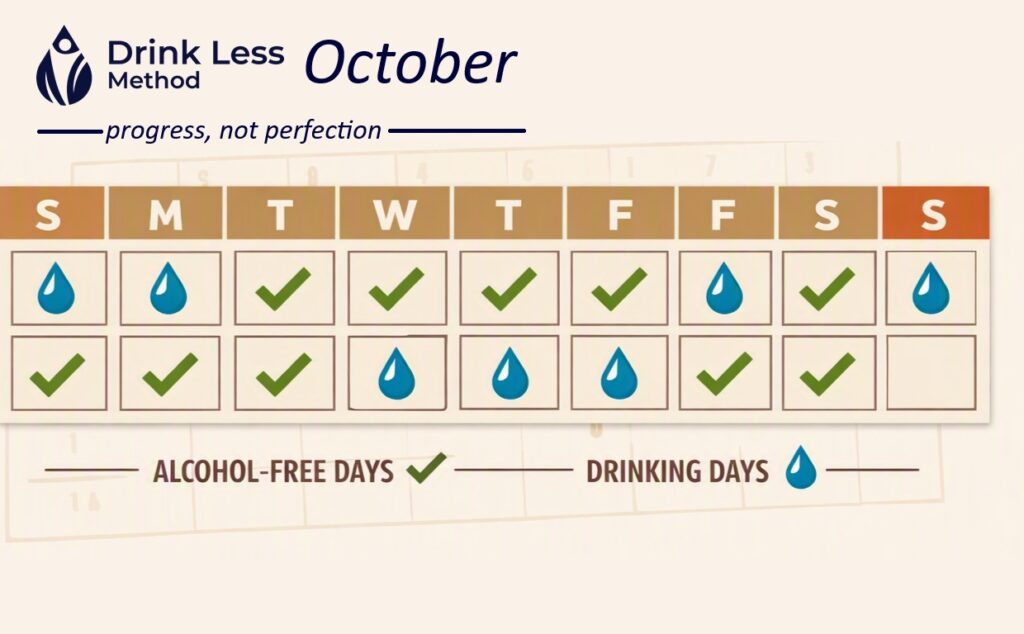
Every October, Sober October encourages people to give up alcohol for the month.
For many people, it’s a useful challenge. Taking a break from drinking can provide an opportunity to look at your habits, discover how often alcohol has become part of your routine and think about whether you’d like to make some longer-term changes.
But there’s one problem.
What if you don’t actually want to stop drinking?
Perhaps you enjoy sharing a bottle of wine over dinner, having a couple of beers with friends or ordering a drink when you’re out.
Your concern isn’t necessarily that you drink alcohol. It’s that you sometimes drink more than you’d like.
If that sounds familiar, why not try something different this October?
Instead of Sober October, have a Drink Less October.
What Is Drink Less October?
The idea is simple.
Rather than measuring success by whether you manage 31 days without a single alcoholic drink, use October to see whether you can reduce how much and how often you drink.
For example, you might aim to:
- Have more alcohol-free days each week.
- Reduce the number of drinks you have on a typical evening.
- Stop automatically topping up your glass.
- Drink more slowly.
- Replace some alcoholic drinks with alcohol-free alternatives.
- Keep track of your weekly units.
- Avoid drinking simply because it’s a particular time of day.
The objective isn’t perfection.
It’s to become more aware of your drinking and begin changing the habits that may have gradually developed around alcohol.
Week One: Find Out How Much You’re Actually Drinking
Start by tracking your alcohol consumption.
This sounds simple, but it can be surprisingly revealing.
Record every alcoholic drink for seven days and, ideally, calculate the number of alcohol units you’re consuming.
A large glass of wine, for example, can contain considerably more than one unit. The exact amount depends on both the size of the glass and the strength of the wine.
Week Two: Start Making Changes
Now look at your first week’s drinking diary.
Which drinks would you genuinely miss?
And which could you quite happily do without?
This distinction matters.
Perhaps you really enjoy going out for dinner on Saturday and sharing some wine. But the Wednesday evening drinks at home have simply become a habit.
Start with the easier changes.
If you normally drink five nights each week, could you make it three?
If you normally have three glasses of wine, could you stop after two?
Small reductions can accumulate across a week and a month.
Week Three: Challenge Your Drinking Habits
By the third week, start paying attention to why you reach for a drink.
Sometimes we consciously decide to drink.
At other times, alcohol becomes connected with a routine.
Finish work. Open wine.
Start cooking. Pour a drink.
Friday evening. Go to the pub.
Sit down to watch television. Open a beer.
These associations can become surprisingly powerful because they’re repeated week after week.
Try disrupting them.
Go for a walk after work. Have an alcohol-free drink while you’re cooking. Don’t keep the bottle beside you. Change what you do during the first hour after arriving home.
You may find that changing the routine surrounding alcohol makes reducing it easier.
Week Four: Decide What Your New Normal Looks Like
The final week is arguably the most important.
Compare your drinking with the beginning of October.
Are you drinking fewer units?
Have you introduced more alcohol-free days?
Are you stopping earlier?
Do you feel more in control of when you drink?
Then ask yourself what you could realistically continue doing in November.
This is where Drink Less October potentially differs from a temporary abstinence challenge.
The objective isn’t necessarily to reach 1 November and say:
“I did it.”
It’s to reach November and say:
“This is how I’d like to drink from now on.”
What If Drinking Less Is Harder Than You Expected?
For some people, deciding to drink less is relatively straightforward.
For others, it isn’t.
You might start an evening intending to have two drinks but repeatedly find yourself having four or five. You might struggle with cravings, or discover that once you start drinking, stopping is much harder than you expected.
If that happens, it’s useful information rather than a reason to give up.
There are different approaches to reducing alcohol consumption, including practical behavioural strategies, professional support and, for some people, prescription medication following an appropriate clinical assessment.
Drink Less Method is designed specifically for adults whose goal is to reduce their alcohol consumption rather than necessarily stop drinking completely.
The service includes an online health assessment followed by an independent clinical review to determine whether treatment is appropriate. Prescription medication isn’t suitable for everyone and treatment decisions are made individually by the clinician.
You can learn more at www.drinklessmethod.co.uk.
Make October About Control, Not Perfection
Sober October can be a great challenge if abstinence is what you want.
But it isn’t the only way to use October to reconsider your relationship with alcohol.
If you don’t want to stop drinking altogether, set yourself a different challenge.
Drink less. Drink more consciously. Track what you’re drinking. Break some of the automatic habits. And see how much you can change in 31 days.
Because success doesn’t necessarily have to mean never drinking again.
For many people, the goal is much simpler:
Enjoy alcohol when you choose to drink—but feel more in control of how much you consume.