
Which Approach Can Help You Change Your Drinking Habits?
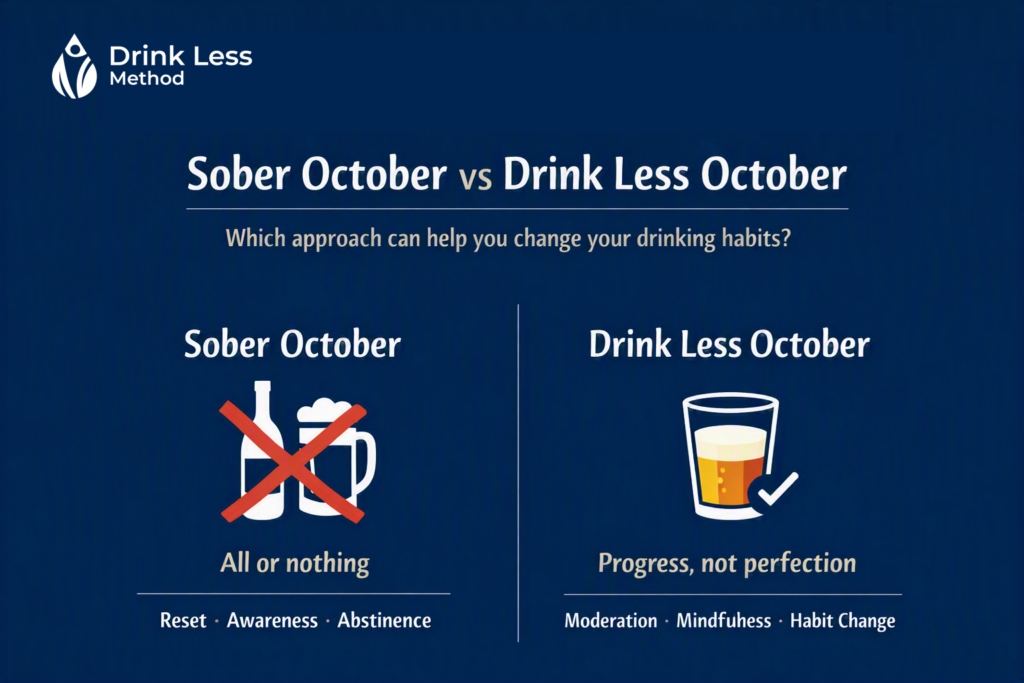
October has become a popular time to reconsider our relationship with alcohol.
For many people, that means Sober October: taking a complete break from alcohol for the month. It’s a simple challenge with an equally simple rule—don’t drink during October.
But complete abstinence isn’t everyone’s goal.
Some people don’t want to stop drinking altogether. They enjoy alcohol socially or occasionally but feel that the amount they’re drinking has gradually increased.
Perhaps one glass at home has become two or three. Maybe drinking has crept into more evenings of the week. Or perhaps you’re increasingly finding that once you’ve started, you drink more than you originally intended.
In those circumstances, another question might be worth asking:
Instead of stopping drinking completely for a month, could you use October to learn how to drink less?
What Can Sober October Teach You?
Taking alcohol out of your life temporarily can reveal a surprising amount about your drinking habits.
You might notice particular situations in which you automatically think about having a drink.
It could be arriving home after a stressful day, preparing dinner, watching television in the evening or meeting friends at the weekend.
Removing alcohol temporarily interrupts those routines.
That’s potentially useful because drinking isn’t always about making a conscious decision that you particularly want alcohol.
Sometimes it’s simply what you normally do.
A month without drinking can help expose those patterns.
But there’s another question to consider.
What happens when October ends?
The November Problem
Imagine completing 31 days without alcohol.
November arrives and you decide to start drinking again.
You’re now back in the same situations that existed before October: dinners, weekends, stressful days, evenings at home, social events and bottles of wine sitting in the fridge.
If your ultimate goal was permanent abstinence, your alcohol-free October may have been an excellent starting point.
But if you always intended to drink again, the longer-term challenge may be learning how to drink differently.
That’s where an approach based on reduction can offer a different perspective.
What Can Drinking Less Teach You?
Instead of removing alcohol completely, deliberately reducing your drinking means practising making different decisions while alcohol remains available.
For example, you could decide that this October you’re going to stop after two drinks rather than automatically continuing.
Or you might decide that alcohol will only be part of certain occasions rather than something you routinely have at home.
You could also look at the speed at which you’re drinking.
If your first glass disappears in 15 minutes, deliberately making it last considerably longer can change the rhythm of the evening.
The point is to start noticing your decisions rather than drinking on autopilot.
Which Drinks Do You Actually Enjoy?
Here’s an interesting exercise for October.
Before each drink, ask yourself:
Do I actually want this one?
The answer to the first drink might be an enthusiastic yes.
The answer to the second might also be yes.
But what about the third?
Or the drink you automatically pour when you walk through the door after work?
Or the glass you top up before you’ve even finished the previous one?
One aim of drinking less is to separate the drinks you genuinely choose from those that have simply become habitual.
You might discover that reducing alcohol doesn’t necessarily mean giving up the occasions you enjoy most.
Instead, it can mean gradually removing some of the alcohol you don’t particularly value.
Don’t Turn October Into a Pass or Fail Test
Another advantage of setting a reduction goal is that progress doesn’t have to disappear because of one evening.
Suppose your aim is to drink considerably less during October.
You have a wedding halfway through the month and drink more than you intended.
That doesn’t erase everything you’ve achieved during the previous two weeks.
You simply continue the following day.
This can be an important mindset when trying to make longer-term changes.
Instead of asking:
“Was I perfect?”
Ask:
“Am I drinking less than I was before?”
What If You Want to Drink Less but Can’t?
Sometimes people discover that wanting to reduce their drinking and actually doing it are two different things.
You may repeatedly promise yourself you’ll only have a couple of drinks but struggle to stop once you’ve started.
Or you may successfully cut down for several days before gradually returning to your previous drinking pattern.
If that sounds familiar, you aren’t limited to willpower alone.
There are different approaches to alcohol reduction, including changing routines and drinking behaviours, professional support and, for appropriate individuals, prescription treatments.
Drink Less Method is specifically designed for adults who want greater control over their alcohol consumption and whose objective may be reduction rather than complete abstinence.
The process starts with an online health assessment. An independent clinician then considers the information provided and determines whether treatment is clinically appropriate for that individual.
Prescription treatment isn’t suitable for everybody, and the decision to prescribe remains with the clinician.
You can find out how the service works at www.drinklessmethod.co.uk.
So, Sober October or Drink Less October?
There doesn’t have to be a competition between the two.
For some people, taking October completely alcohol-free is exactly what they want.
For others, a different experiment might be more relevant.
Rather than seeing how long you can go without drinking, see what happens when you deliberately change the way you drink.
Track it. Question the automatic drinks. Slow things down. Change your routines. Decide in advance when you’re going to stop.
Most importantly, pay attention to what you learn.
Because whether you choose Sober October or Drink Less October, the most valuable outcome may not be what happens during those 31 days.
It may be what you decide to do differently afterwards.