
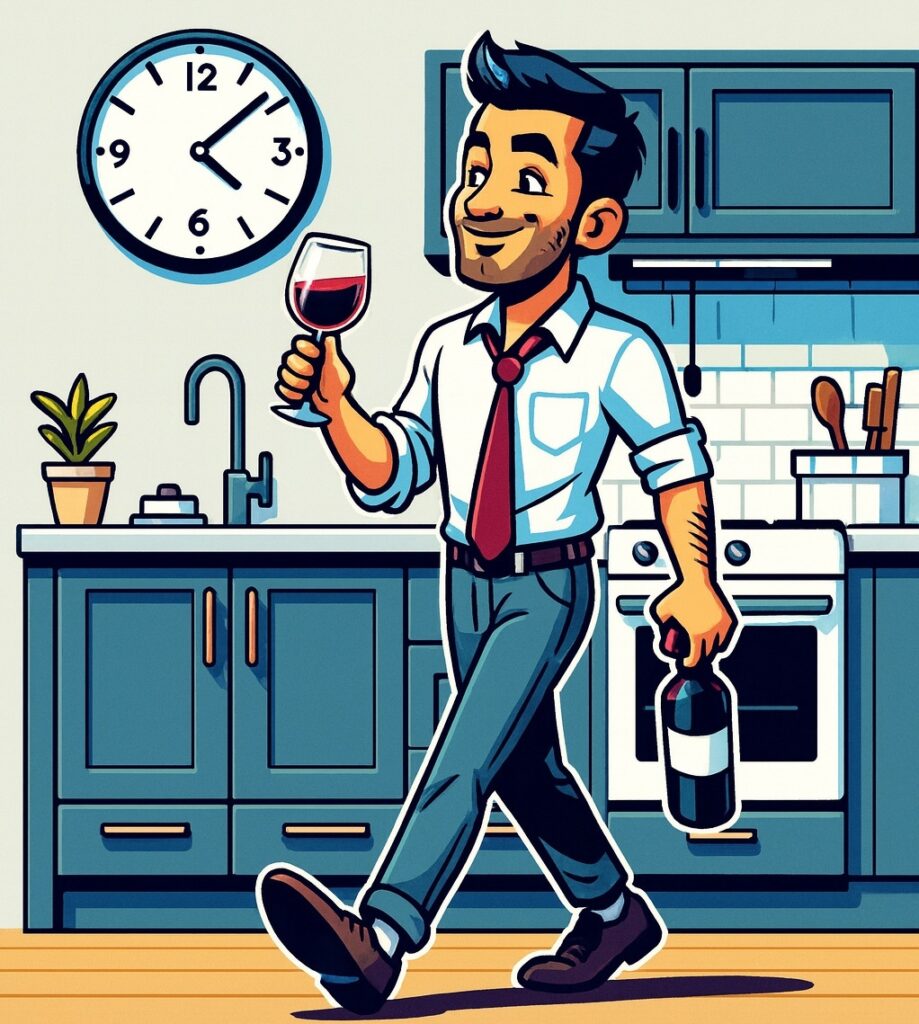
It’s 6pm.
You’ve finished work, started preparing dinner and, almost without thinking, opened a bottle of wine.
Or perhaps your routine is different.
You arrive home, put your bag down and open a beer. Maybe you wait until the children are settled before pouring a gin and tonic. Or perhaps the first glass appears when you sit down in front of the television.
You didn’t necessarily spend the afternoon craving alcohol.
You may not even have consciously decided to drink.
It just happened.
If you’re drinking wine every night or regularly having alcohol after work, one of the most useful questions you can ask yourself is:
“How much of my drinking is a decision, and how much is simply a habit?”
When Drinking Becomes Part of the Routine
Alcohol can become attached to remarkably ordinary moments.
The material from Alcohol Change UK highlights exactly this issue. As people return to their normal routines after the summer, alcohol can quickly find its way back into everyday moments and daily drinking can become habitual.
The examples it gives will probably sound familiar to many people: a glass of wine while preparing dinner or beers while watching television after the day’s jobs are finished.
These routines can become powerful because they’re repeated.
Finish work.
Pour wine.
Cook dinner.
Relax.
Repeat the following evening.
Eventually, simply starting dinner can become associated with having a glass in your hand.
Summer Can Make the Habit Stronger
Summer provides even more opportunities for alcohol to become routine.
A drink in the garden.
Wine with lunch.
A beer in the sunshine.
Cocktails on holiday.
Drinks at a barbecue.
You may have started the summer drinking three nights a week and finished August drinking six or seven.
Then September arrives and the holiday drinking simply turns into after-work drinking.
If you’ve found yourself thinking, “I’ve been drinking too much and need to reduce my drinking,” this is an excellent time to look at those routines.
Why Is It Difficult to Just Say No?
People often assume controlling alcohol is purely about willpower.
They tell themselves:
“I’m not drinking tonight.”
At 10am, that decision feels easy.
At 2pm, it still feels easy.
But then 6pm arrives.
You’re cooking dinner in exactly the same kitchen, at exactly the same time, after exactly the same sort of working day.
Suddenly the wine feels much more tempting.
That doesn’t mean change is impossible. It does show why understanding your personal drinking triggers can be useful.
If a behaviour has become strongly connected with a particular time, place or activity, changing the routine surrounding it can be an important part of reducing alcohol consumption.
Is There a Pill to Stop Drinking?
People struggling with this pattern often start searching online for help.
Common searches include:
“Is there a pill to stop drinking?”
“What medication can help me drink less?”
“Can Naltrexone reduce alcohol cravings?”
“How does the Sinclair Method work?”
There isn’t a magic pill to stop drinking that instantly removes somebody’s relationship with alcohol.
There are, however, prescription medicines used in alcohol treatment.
One of the best known is Naltrexone.
Naltrexone is an opioid-receptor antagonist. It acts on opioid receptors involved in the reinforcing effects associated with alcohol.
For appropriate patients, Naltrexone may be prescribed as part of a medically supervised approach to alcohol treatment.
It isn’t suitable for everybody, it isn’t guaranteed to work for everybody, and it requires appropriate clinical assessment.
John Sinclair, Naltrexone and the Sinclair Method
To understand why Naltrexone and reducing drinking are so often discussed together, it’s worth looking at the pioneering research of Dr John David Sinclair.
Sinclair began studying alcohol-seeking behaviour in the 1970s.
His work explored the role of learning and reinforcement in continued alcohol consumption and subsequently investigated the use of opioid antagonists such as Naltrexone.
The approach associated with his work eventually became widely known as the Sinclair Method.
Central to the Sinclair Method is an idea commonly described as pharmacological extinction.
Put very simply, if drinking alcohol repeatedly produces reinforcement, that reinforcement can contribute to learned drinking behaviour. Sinclair’s research explored whether blocking opioid-mediated reinforcement in association with drinking could, over time, weaken that learned behaviour.
It’s one reason his work has attracted particular interest among people who want to reduce drinking rather than necessarily commit immediately to complete abstinence.
The Drink Less Method is inspired by the pioneering work of John Sinclair and his Sinclair Method, while using its own clinically guided approach.
What Does This Mean for Your 6pm Glass of Wine?
Think about the behaviour you’re trying to change.
Perhaps your problem isn’t that you desperately want alcohol all day.
Instead, a particular situation seems to switch the behaviour on.
For example:
6pm + cooking dinner = wine.
Or:
Finish work + sofa = beer.
Once you’ve recognised that connection, you can start disrupting it.
Alcohol Change UK suggests identifying the two or three situations in which you’re most likely to drink more than you’d like and making simple decisions in advance about what you’ll do when those moments occur.
That’s a useful idea because you’re making the decision before the trigger appears.
Change What Happens at 6pm
If you always drink while cooking, try changing the routine.
Go for a short walk before making dinner.
Have an alcohol-free alternative ready.
Change what you’re cooking or where you eat.
Don’t automatically put a bottle of wine in the fridge.
Decide your alcohol-free evenings at the beginning of the week.
And most importantly, track every drink.
You may discover that the glass you think you’re having “occasionally” actually appears nearly every evening.
What If You Keep Falling Back Into the Same Pattern?
Perhaps you’ve already tried all of this.
You’ve promised yourself you’ll only drink at weekends.
You’ve tried alcohol-free Mondays.
You’ve stopped buying wine.
You’ve downloaded a tracking app.
Yet gradually you find yourself drinking every night again.
If repeated attempts to reduce drinking haven’t produced the change you want, you may decide to explore whether additional support or medication to reduce drinking could be appropriate.
That’s where learning about Naltrexone may be useful.
Could Naltrexone Help You Reduce Drinking?
At the Drink Less Method, the objective is to help suitable adults regain greater control over their alcohol consumption.
For some people, success means stopping completely.
For others, it means being able to drink less alcohol and feel more in control of when and how much they consume.
Adults can complete a confidential online assessment, after which an independent prescriber determines whether prescription treatment is clinically appropriate.
Naltrexone isn’t simply a pill to stop drinking, and medication shouldn’t replace understanding your own drinking patterns.
Instead, think about the bigger picture:
- Recognise the trigger.
- Measure the drinking.
- Change the routine.
- Seek appropriate support when you need it.
People who may be physically dependent on alcohol shouldn’t suddenly stop or substantially reduce their consumption without medical advice, because alcohol withdrawal can sometimes be dangerous.
Take Back Control of 6pm
The end of summer and return to work is an ideal opportunity to look at your drinking habits.
Next time 6pm arrives, notice what happens.
Do you actively decide that you want a drink?
Or do you find yourself opening the bottle almost automatically?
That simple observation could tell you something important.
The research begun by John Sinclair in the 1970s, his subsequent work associated with the Sinclair Method, and the wider evidence surrounding Naltrexone have contributed to a different way of thinking about alcohol and learned drinking behaviour.
If your goal is to reduce drinking, you don’t necessarily have to wait until the problem gets worse before looking for help.
Sometimes the first step is simply recognising that the 6pm glass of wine has stopped being a conscious choice.
And deciding that you’d like to make it one again.
Want to Find Out More About Naltrexone and Reducing Your Drinking?
Learn more about Naltrexone, the Sinclair Method, medication to reduce drinking and the Drink Less Method’s approach for suitable adults who want to regain greater control over alcohol.
Find out more: www.drinklessmethod.co.uk